
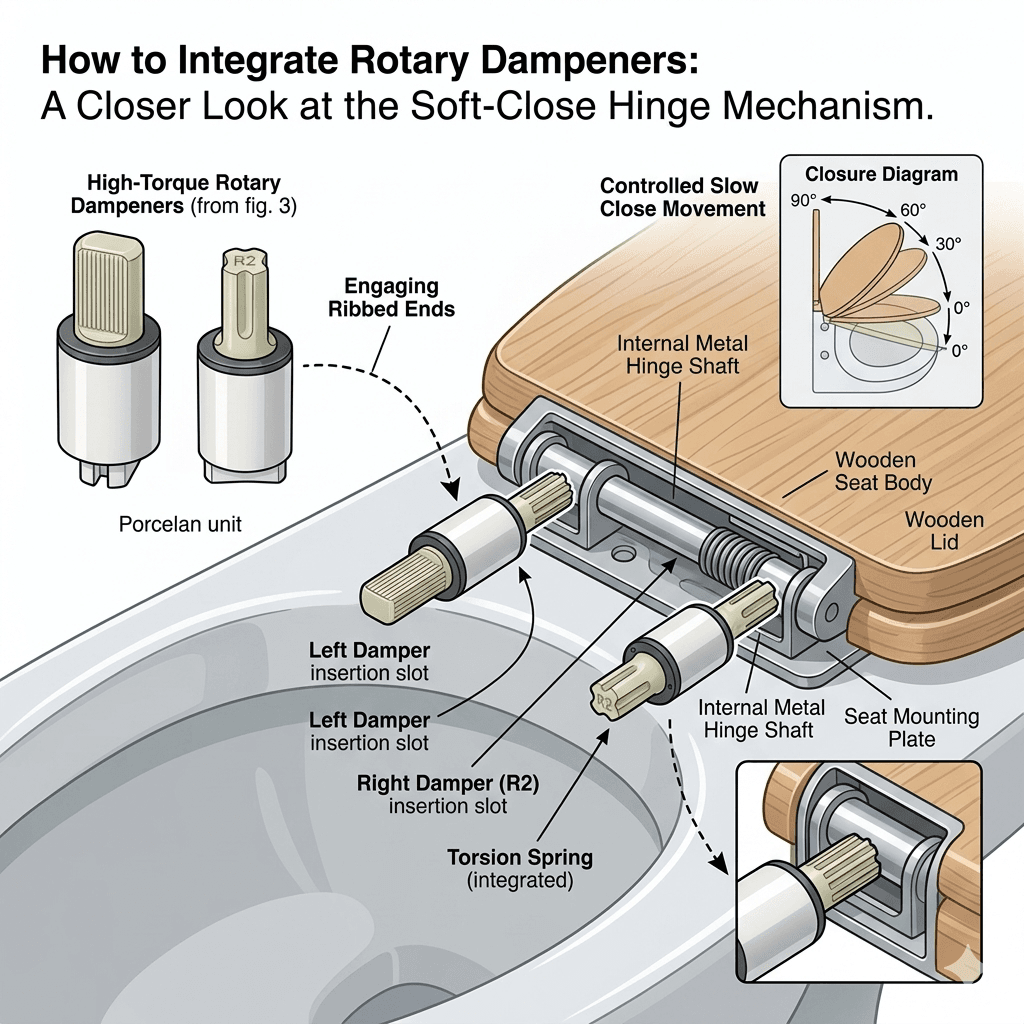
In the modern sanitary ware industry, the “luxury” of a product is no longer defined solely by its ceramic glaze or aesthetic lines. It is defined by the last three seconds of its movement. Whisper-close and slow-close functionalities have transitioned from premium features to baseline expectations for high-end bathrooms.
As a specialized manufacturer of high-precision rotary dampers, we understand that for product engineers and sourcing leads, choosing a rotary damper is not just about a component—it is about managing warranty risks and enhancing brand equity.
I. The Physics of Motion Control: How Rotary Dampers Work
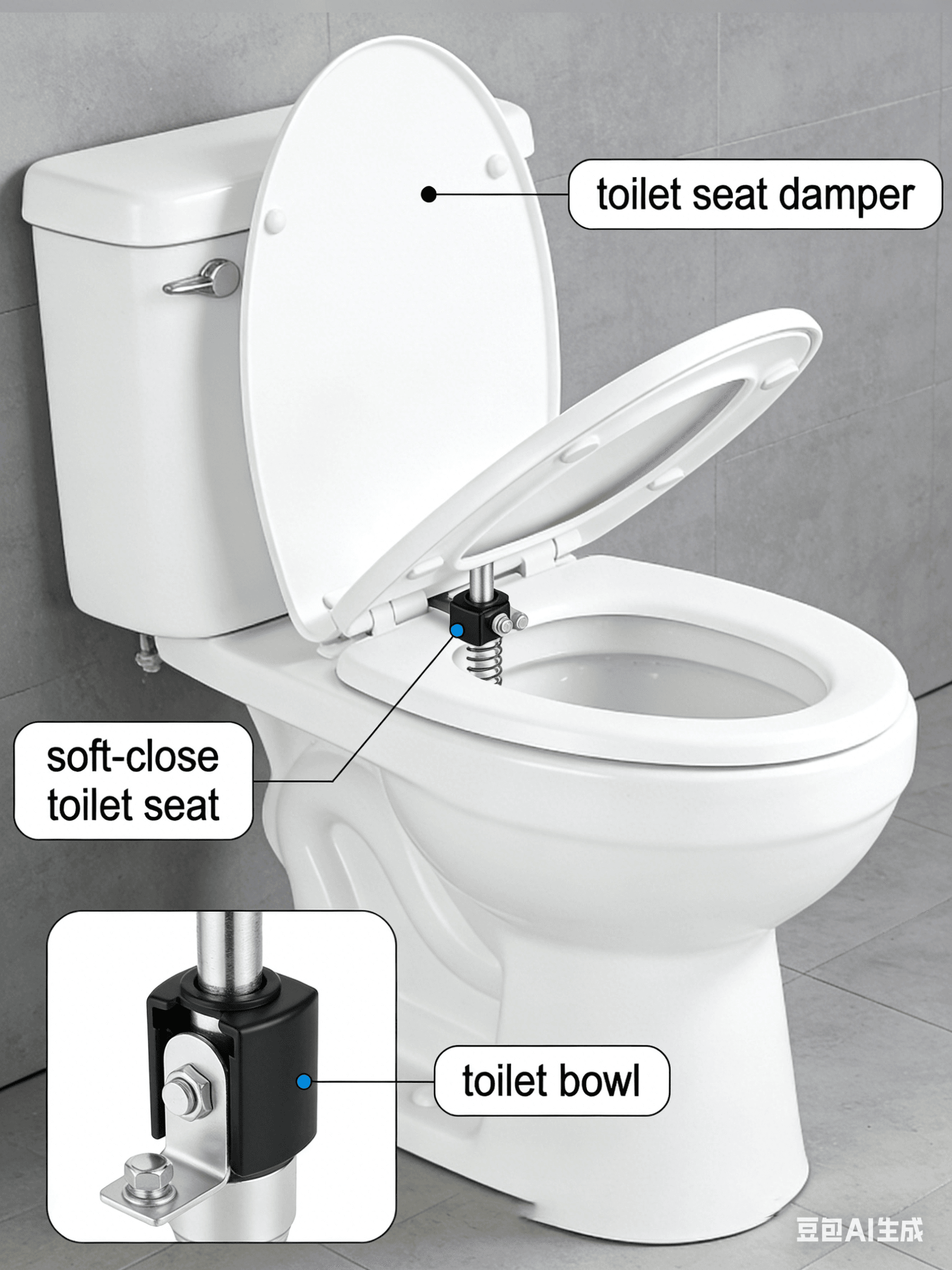
The ability of a toilet seat to defy gravity and descend at a constant, silent velocity relies entirely on the rotary damper integrated into the hinge. The core mechanism is based on viscous shear stress.
1. The Anatomy of a High-Performance Damper
A professional-grade damper consists of four critical elements:
- Rotor & Housing: Usually molded from high-performance engineering plastics (like POM or glass-filled PA66) to ensure dimensional stability and chemical resistance.
- High-Viscosity Silicone Oil: The medium that generates resistance.
- Sealing System (O-Rings): Typically made of Fluorocarbon (FKM) or Silicone rubber to prevent leakage—the “Achilles’ heel” of poor-quality dampers.
- One-Way Valve Mechanism: This ensures the seat provides resistance during descent but remains light and easy to lift.
2. The Operating Principle
When the seat lids falls, the rotor turns within a sealed chamber filled with silicone oil. The oil is forced through a microscopic gap (orifice) between the rotor vanes and the housing. The damping force is governed by the formula:
F=η⋅A⋅dv/dy
By precision-engineering these gaps, we can calibrate the exact torque required to counteract the increasing gravitational pull as the toilet seat nears the bowl.
II. The Engineer’s Checklist: Evaluating Damper Performance
When validating a supplier, “it works” is not a sufficient metric. Engineers must look at three “hard” technical indicators:
1. Torque Curve Consistency
The gravitational torque of a toilet seat changes dynamically from 110° to 0°. A superior damper must provide a non-linear damping force to compensate, ensuring a smooth transition without “stalling” at the top or “slamming” at the bottom.
2. Thermal Stability (Viscosity Index)
Silicone oil viscosity fluctuates with temperature. Cheap dampers cause the seat to stay open indefinitely in winter or slam shut in summer. We utilize High Viscosity Index (HVI) oils to ensure that the closure time deviation remains within $\pm 3$ seconds between $5^{\circ} \text{C}$ and $50^{\circ} \text{C}$.
3. Fatigue Life & Durability
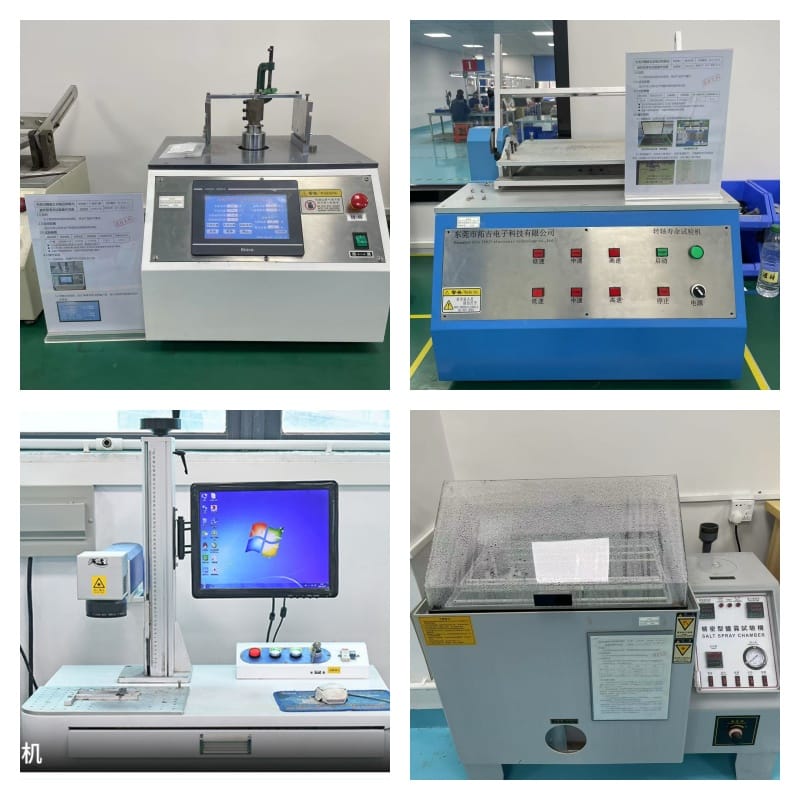
While industry standards often cite 30,000 cycles, our factory standard is 50,000 cycles with less than 15% torque decay. This requires seals that resist physical deformation under constant shear stress over years of use.
III. Procurement Strategy: Avoiding the “Hidden Costs” of Cheap Components
For a Procurement Manager, the unit price is visible, but the hidden costs (returns, after-sales service, and brand damage) can be catastrophic.
1. The Leakage Risk
90% of soft-close failures are due to oil leakage. This is rarely accidental; it is usually caused by:
- Material Porosity: Micro-voids in the plastic housing due to poor injection molding.
- Inferior Sealing: Using single-seal designs instead of double-seal structures.
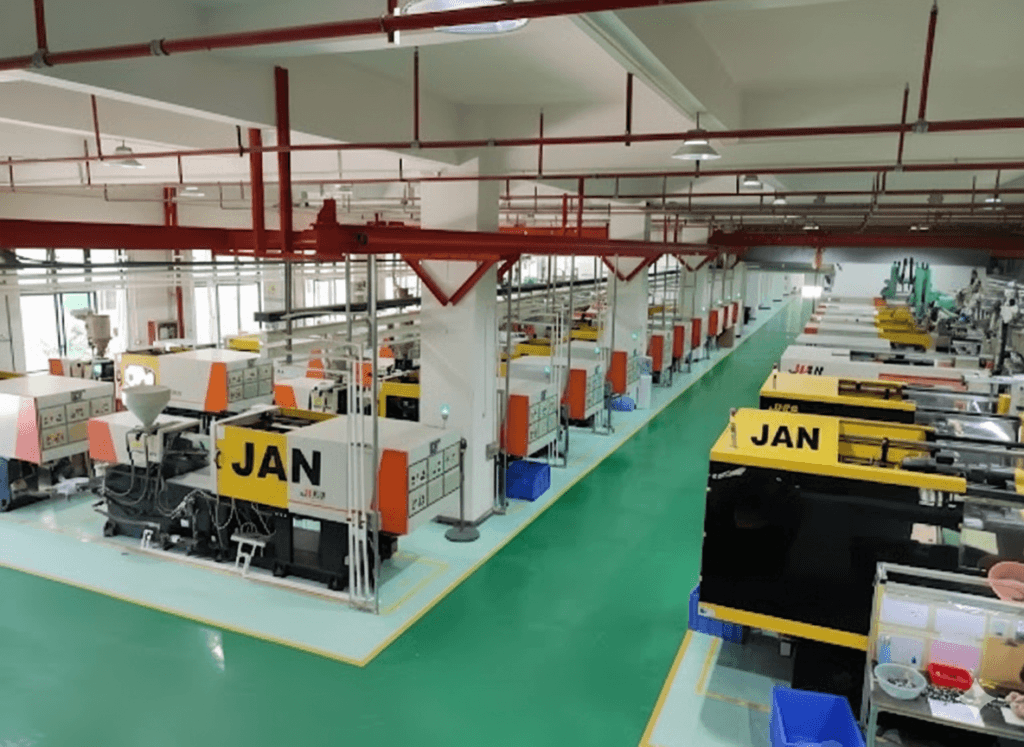
- Lack of Testing: Does the supplier perform 100% vacuum leak testing on the assembly line?
2. Recycled vs. Virgin Materials
Some factories use recycled resins to lower costs. Over time, these materials suffer from Environmental Stress Cracking (ESC) when in contact with silicone oil, leading to sudden housing failure. We use 100% virgin engineering polymers to guarantee structural integrity.
3. Torque Customization (Fit-and-Forget)
A heavy Urea-Formaldehyde (UF) seat requires vastly different damping than a lightweight Polypropylene (PP) seat. A “one size fits all” approach leads to inconsistent user experiences. We provide customized torque calibration based on your specific seat weight and center of gravity.
IV. Why Partner With Our Factory?
We are more than a component supplier; we are your engineering partners in motion control.
| Feature | Our Engineered Solution | Standard Market Grade |
| Sealing Tech | Imported FKM + Ultrasonic Welding | Domestic Nitrile + Glue Bonding |
| Silicone Oil | Original Japanese/German HVI Oil | Generic oil; highly temp-sensitive |
| Consistency | Automated assembly; <5% torque deviation | Manual assembly; high variance |
| Compliance | Full SGS, RoHS, and REACH Certification | Partial or missing documentation |
Why does the closing time of soft-close toilet seats vary in winter and summer?
This is primarily due to the Temperature Sensitivity of the silicone oil inside the damper. Standard silicone oil thickens in cold temperatures and thins in heat. To mitigate this, our dampers utilize High Viscosity Index (HVI) oil imported from Japan or Germany. This ensures that the closure time remains stable (typically within a ± 3 second deviation) even when temperatures fluctuate between 5°C and 50°C.
What are the primary causes of oil leakage, and how does your factory prevent it?
Leakage usually stems from poor sealing or material fatigue. We prevent this through a dual-layered approach: first, we use premium FKM (Fluorocarbon) O-rings which offer superior chemical resistance to silicone oil; second, we employ Ultrasonic Welding for the housing instead of simple glue bonding. Furthermore, every single unit undergoes a 100% vacuum leak test before leaving the assembly line.
Can one damper model fit all types of toilet seats (PP, UF, or Slim designs)?
No. A “one-size-fits-all” approach leads to either “slamming” (if the seat is too heavy) or “stalling” (if the seat is too light). The torque must be matched to the weight and center of gravity of the lid. We provide customized torque calibration ranging from 0.2Nm to 5Nm to ensure a perfect 110-degree smooth descent for your specific product material.
Is there a difference between the damping force when opening vs. closing?
Yes. An ideal user experience requires high resistance during closing but minimal resistance during opening. Our dampers feature a specialized One-Way Valve (Check Valve) mechanism. This allows the oil to flow freely when the seat is lifted, making it feel light and effortless for the user, while providing controlled viscous resistance only during the descent.
How do you guarantee a 50,000-cycle lifespan without performance decay?
Longevity depends on Material Integrity. Many budget manufacturers use recycled plastics which suffer from Environmental Stress Cracking (ESC) when in contact with silicone oil. We use 100% virgin engineering polymers (PA66+GF or POM). Combined with our precision-engineered vane structures, this minimizes internal friction and maintains torque stability for over 50,000 cycles—far exceeding the standard 30,000-cycle industry requirement.
V. Conclusion: Turn a Component into a Brand Asset
A quiet, smooth-closing toilet seat is a silent ambassador for your brand’s quality. In an era where automatic closing and rotational damping are benchmarks for hygiene and comfort, choosing a manufacturer with a rigorous QC system is the best investment in risk mitigation.
Don’t let a single “thump” in the middle of the night ruin your customer’s perception of your product.
Are you facing any of these challenges?
- High return rates due to oil leakage?
- Slow-close seats that “freeze” in cold climates?
- Difficulty finding the right torque for a new, heavy seat design?
We offer free sample testing and technical torque analysis for your specific models.
Would you like us to provide a customized torque selection report based on your seat’s weight and dimensions?