
If you spend enough time looking at mechanical drawings and BOMs (Bill of Materials), you will eventually hit the classic engineering dilemma: Do we specify stainless steel or aluminum for this component?
When it comes to friction hinges (also known as torque hinges or position control hinges), this decision is rarely just about cost. It is about how the hinge will perform under continuous stress, how it will handle environmental exposure, and whether its weight will throw off the balance of your entire assembly.
I have seen product designers default to stainless steel simply because “it is stronger,” only to realize later that the added weight makes their portable device feel like a brick. Conversely, I have seen engineers choose aluminum to save money, only to watch the hinges corrode after six months in a marine environment.
In this guide, we will break down the real-world differences between stainless steel and aluminum friction hinges. We will look past the basic spec sheets and dive into what these materials actually mean for your product’s lifespan, performance, and bottom line.

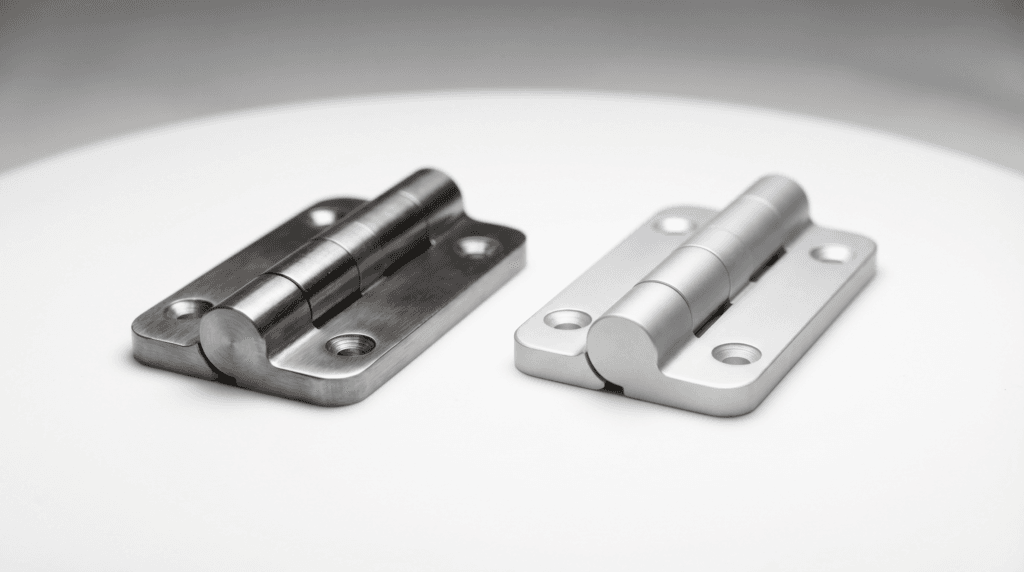
Side-by-side comparison: The heavy, robust build of a stainless steel friction hinge (left) versus the lightweight, anodized finish of an aluminum alloy hinge (right).
The Baseline: Understanding the Materials
Before we compare them, let us establish exactly what materials we are talking about in the context of industrial friction hinges.
Stainless Steel (Typically 304 or 316 Grade)
When a manufacturer specifies a “stainless steel friction hinge,” they are almost always referring to Austenitic stainless steel—usually grade 304 or 316.
•304 Stainless Steel: The industry standard. It offers excellent strength and good corrosion resistance for most indoor and general outdoor applications.
•316 Stainless Steel: The “marine grade.” It contains molybdenum, which drastically increases its resistance to chlorides (like salt water and de-icing salts).
Aluminum Alloy (Typically 6000 Series)
Aluminum friction hinges are rarely made from pure aluminum, which is too soft for structural applications. Instead, they are machined or die-cast from aluminum alloys, most commonly the 6000 series (like 6061-T6). These alloys are blended with magnesium and silicon to provide a high strength-to-weight ratio. They are almost always anodized to improve surface hardness and corrosion resistance.
Head-to-Head Comparison: The 4 Key Factors
When choosing between a stainless steel friction hinge and an aluminum one, your decision will ultimately come down to four engineering factors: Weight, Strength, Environmental Resistance, and Cost.

A quick visual breakdown of how 304/316 stainless steel stacks up against 6061 aluminum alloy across key engineering metrics.
1. Weight and Density (The Aluminum Advantage)
If your product needs to be carried, flown, or mounted on a delicate surface, weight is your primary constraint.
Aluminum is exceptionally light. With a density of roughly 2.7 g/cm³, it is about 65% lighter than stainless steel (which sits at around 7.9 g/cm³).
What this means for your design:
If you are designing a ruggedized laptop, a medical tablet, or an aerospace interior panel, aluminum friction hinges are almost always the right choice. A heavy stainless steel hinge on a lightweight carbon-fiber lid will shift the center of gravity, potentially causing the device to tip over when the screen is pushed back. Aluminum keeps the assembly balanced.
2. Tensile Strength and Durability (The Stainless Steel Advantage)
Friction hinges operate by generating constant resistance against movement. This means the internal components (the shaft, the friction bands, and the housing) are under constant mechanical stress.
Stainless steel is significantly stronger and harder than aluminum. A typical 304 stainless steel has a tensile strength of around 505-515 MPa, whereas 6061-T6 aluminum sits around 310 MPa. More importantly, stainless steel has a much higher fatigue limit.
What this means for your design: or Discuss more on Whatsapp.
If you are designing a heavy-duty industrial enclosure, a thick blast-proof door, or a machine guard that weighs 50 lbs, you need stainless steel. Aluminum hinges, under extreme continuous loads, are more susceptible to deformation or “creep” over time. Stainless steel will hold its torque rating more consistently under heavy payloads.
3. Corrosion and Environmental Resistance
Both materials offer good corrosion resistance, but they achieve it in entirely different ways—and they fail in different environments.
Aluminum: Relies on a microscopic layer of aluminum oxide (often artificially thickened via anodizing) to prevent rust. It performs beautifully in normal indoor environments and light outdoor use. However, if the anodized layer is scratched, or if the hinge is exposed to highly alkaline or highly acidic environments, the aluminum will begin to pit and degrade rapidly.
Stainless Steel: Relies on chromium to form a passive, self-healing oxide layer. If you scratch a 304 or 316 stainless hinge, the chromium instantly reacts with oxygen in the air to repair the protective barrier.
What this means for your design:
For indoor consumer electronics or office equipment, aluminum is perfectly fine. But if your friction hinge is going on a boat hatch (saltwater), a food processing machine (harsh chemical washdowns), or an outdoor EV charging station in a coastal city, you must use 316 stainless steel. Aluminum will not survive long-term in those conditions.
4. Cost and Manufacturability
Let us talk about the budget. As a raw material, aluminum is generally cheaper than stainless steel. Furthermore, aluminum is much softer and has a lower melting point, making it significantly easier (and faster) to machine, extrude, or die-cast.
Stainless steel is notorious for chewing through CNC tooling and requires much more energy to cast or stamp.
What this means for your design:
At scale, an aluminum friction hinge will almost always cost less to produce than an identical stainless steel version. If you are manufacturing 100,000 units of a consumer device where every penny counts, and the environment allows for it, aluminum is the financially sound choice.
Application Scenarios: Making the Final Call
Still on the fence? Here is how we typically advise our OEM clients based on their specific industries.

Use this decision tree to match your application scenario with the optimal friction hinge material.
Choose Aluminum Friction Hinges If:
•You are designing portable electronics: Laptops, rugged tablets, and gaming handhelds require the absolute minimum weight.
•You are building aerospace interiors: Every ounce matters in an aircraft cabin. Aluminum torque hinges are standard for overhead bins and folding tray tables.
•Cost is a strict constraint: For high-volume, indoor, light-duty applications (like adjustable desk lamps or camera monitors), aluminum provides the best ROI.
Choose Stainless Steel Friction Hinges If:
•You are in the Marine Industry: Boat hatches, radar mounts, and deck storage lids demand 316 stainless steel to survive saltwater spray.
•You are building Medical or Food-Grade Equipment: These environments require harsh, high-temperature chemical sterilization. Aluminum will degrade under these cleaning protocols; 304 or 316L stainless steel will not.
•You are dealing with heavy industrial loads: If the door or panel you are holding open weighs more than 30 lbs, the structural integrity of a heavy-duty stainless steel hinge is required to prevent long-term torque decay.
The JAN Hinge Engineering Verdict
At JAN Hinge, we manufacture both stainless steel and aluminum friction hinges because no single material solves every engineering problem.
The biggest mistake you can make is over-engineering (paying for 316 stainless steel on an indoor office device) or under-engineering (using aluminum on an outdoor telecom enclosure to save $2 per unit, only to face massive warranty claims later).
If you have calculated your torque requirements but are still unsure which material will best balance your performance needs and budget, you do not have to guess. Contact our engineering team today. We can review your CAD files, assess your environmental requirements, and provide free samples of both materials so you can test the tactile feel for yourself, or Discuss more on Whatsapp.
Frequently Asked Questions (FAQs)
1. Can an aluminum friction hinge provide the same torque as a stainless steel one?
Yes, initially. The torque in a friction hinge is generated by the internal friction bands or clips gripping the shaft, not just the outer housing material. We can engineer an aluminum hinge to output the exact same N·m rating as a stainless one. However, for very high-torque applications, a stainless steel housing provides better structural support against the internal rotational forces over a lifespan of 50,000+ cycles.
2. Does anodized aluminum prevent galvanic corrosion?
Anodizing provides an excellent insulating barrier, but it is not foolproof. If you mount an aluminum friction hinge onto a stainless steel panel (or use stainless steel screws to mount it) in a wet or humid environment, galvanic corrosion can occur where the metals touch. If you must mix metals, you should use nylon washers or dielectric grease to isolate them.
3. Are stainless steel friction hinges completely rust-proof?
No metal is 100% rust-proof under all conditions. While 304 stainless steel is highly resistant to rust in normal environments, it can develop “tea staining” if exposed to harsh chlorides. For true marine or highly corrosive environments, you must specify 316 stainless steel, which contains molybdenum for enhanced chloride resistance.
4. Why do medical devices specifically require 316L stainless steel hinges?
Medical equipment (like surgical lighting arms or incubator lids) must undergo rigorous sterilization processes, often involving autoclaves (high heat and steam) and harsh chemical disinfectants like bleach or hydrogen peroxide. Aluminum will pit and corrode under these conditions. 316L stainless steel (the “L” stands for low carbon) prevents carbide precipitation during welding and withstands aggressive sterilization.
5. Can I get custom finishes on both materials?
Yes. Aluminum is highly versatile for aesthetic finishes—it can be anodized in almost any color (black, silver, red, etc.) to match your product’s industrial design. Stainless steel is typically offered in a brushed (satin) finish, a polished (mirror) finish, or can be electroplated/powder-coated if a specific color is required, though this adds to the cost. Discuss more on Whatsapp.