
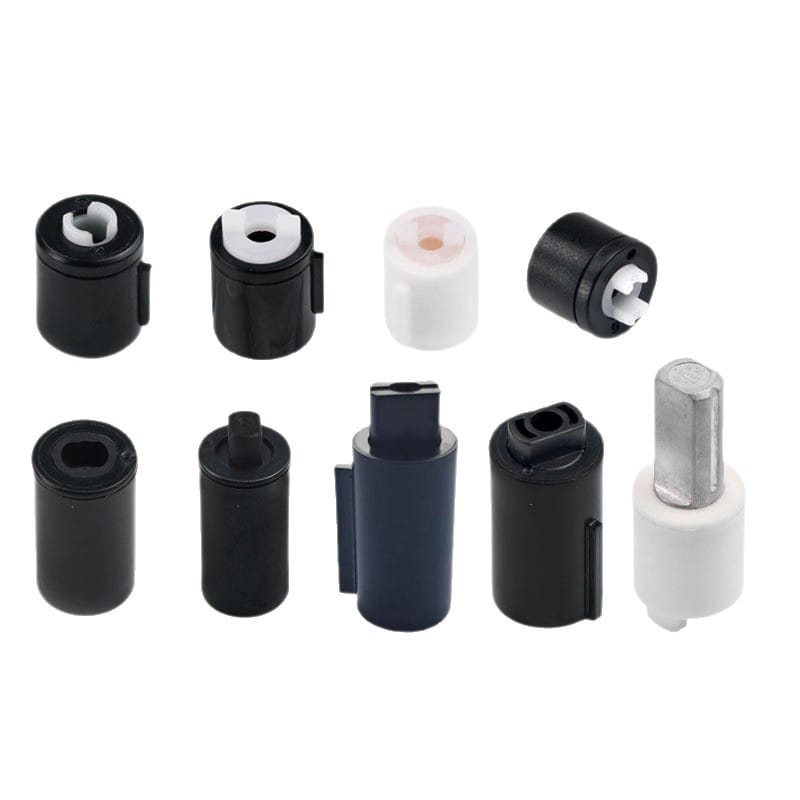
Have you ever noticed how a premium car’s glove box glides open with a silent, luxurious slowness, while a cheaper model’s glove box simply drops open and bounces? Or how a modern toilet seat lowers itself silently instead of slamming shut with a startling crash? This subtle but profound difference in user experience is the direct result of a small, often overlooked mechanical component: the rotary damper.
In the world of product design, motion control is synonymous with quality. A slamming lid or a rapidly falling door not only feels cheap but can also cause premature wear, noise pollution, and even physical injury. Rotary dampers are the engineering solution to these problems, providing what the industry calls “soft-close” or “damped motion.”
Whether you are an engineer designing the next generation of smart home appliances, or a procurement manager sourcing components for automotive interiors, understanding how rotary dampers work and where they add the most value is essential. This comprehensive guide explores the mechanics, applications, and selection criteria for rotary dampers across multiple industries. Let’s talk more on Whatsapp
1. The Mechanics: How Do Rotary Dampers Work?

At its core, a rotary damper is a fluid dynamic device. Unlike friction hinges, which use solid-to-solid contact to hold a position against gravity, rotary dampers use fluid resistance to slow down continuous motion.
The basic architecture of a rotary damper consists of four main elements:
- Outer Housing: The stationary body of the damper, usually made of high-strength plastic or zinc alloy.
- Internal Rotor (Vane or Gear): The moving component connected to the external shaft.
- Silicone Oil: The damping medium. Silicone oil is used because its viscosity remains relatively stable across a wide range of temperatures, ensuring consistent performance whether it is freezing cold or boiling hot.
- Sealing Mechanism: O-rings and ultrasonic welding ensure the fluid never leaks over the product’s lifespan.
When an external force (like gravity pulling a lid down) causes the shaft to rotate, the internal rotor turns inside the housing. As it turns, it forces the highly viscous silicone oil through narrow gaps or valves. The resistance of the oil flowing through these tight spaces generates damping torque, which counteracts the rotational speed. The faster the lid tries to fall, the more resistance the damper provides, resulting in a smooth, controlled descent.
One-Way vs. Two-Way Damping
Engineers can specify dampers to operate in one direction or both. A two-way damper provides resistance when opening and closing. However, most applications use a one-way damper (asymmetric damping). In a one-way damper, a tiny internal check valve opens in one direction, allowing the oil to flow freely (making it easy to lift a lid), but closes in the other direction, forcing the oil through the narrow gap to provide soft-close resistance when the lid falls.
2. Key Industry Applications for Rotary Dampers
The versatility of rotary dampers means they are found in almost every room of a modern house, inside every vehicle, and across industrial floors. Here is how different industries leverage this technology.
Sanitary Ware: The Soft-Close Toilet Seat

Perhaps the most universally recognized application of a rotary damper is the soft-close toilet seat. Before the integration of dampers, dropping a heavy ceramic or thermoset plastic seat resulted in a loud, jarring noise and potential damage to the toilet bowl. Today, a pair of small vane dampers integrated into the hinge mechanism allows the seat and lid to lower themselves silently and gently over 3 to 5 seconds. These dampers must be highly durable, surviving tens of thousands of cycles in a humid bathroom environment without leaking or losing torque.
Automotive Interiors: The Luxury Feel

In the automotive industry, “NVH” (Noise, Vibration, and Harshness) is a critical metric for vehicle quality. Rotary dampers are essential NVH components. They are used in glove boxes, sunglass holders, center console storage bins, and cup holder covers. A glove box damper is typically a small gear damper that engages with a curved gear rack on the side of the glove box door. When the latch is released, the damper ensures the door glides open smoothly rather than falling onto the passenger’s knees. Automotive dampers face strict requirements: they must perform consistently from -40°C in winter to +85°C in a sun-baked cabin.
Home Appliances and Furniture: Kitchen Cabinets and Washing Machines

In the kitchen, slamming cabinet doors are a thing of the past thanks to soft-close damper hinges. These sophisticated hinges use a spring to pull the door closed, while a miniature rotary damper engages in the final 20 degrees of motion to absorb the kinetic energy and pull the door shut silently.
In larger appliances, such as top-load washing machines, heavy glass lids pose a safety risk if they fall on a user’s hands. Heavy-duty rotary dampers are installed at the pivot points to ensure the heavy glass lid closes at a safe, controlled speed, protecting both the user and the appliance’s glass.
3. Rotary Damper vs. Friction Hinge: Which Do You Need?
A common point of confusion for engineers is deciding between a rotary damper and a friction hinge. While both control motion, their functions are fundamentally different:
| Feature | Rotary Damper | Friction Hinge (Torque Hinge) |
|---|---|---|
| Primary Function | Slows down continuous motion (Soft-Close) | Holds an object at a specific angle (Position Control) |
| Mechanism | Fluid resistance (Silicone Oil) | Mechanical friction (Steel bands/disks) |
| Behavior when released | Object continues to move, but slowly | Object stops and stays exactly where released |
| Typical Application | Toilet seats, glove boxes, piano covers | Laptop screens, medical monitors, display panels |
If your goal is to prevent a lid from slamming when gravity takes over, you need a rotary damper. If your goal is to allow a user to adjust a screen to 45 degrees and have it stay there hands-free, you need a friction hinge. In some advanced applications, engineers use both: a friction hinge for the first 150 degrees of motion, and a damper for the final 30 degrees of soft-closing.
4. Engineering Selection: How to Calculate Damper Torque
Selecting the right rotary damper requires calculating the maximum torque generated by the falling object. If the damper is too weak, the lid will still slam. If it is too strong, the lid will not close completely or will take an frustratingly long time to drop.
The basic formula for calculating the required torque (T) is:
T (Nm) = L/2 × W × 9.8
Where:
L = Length of the lid from the hinge pivot to the edge (in meters)
W = Weight of the lid (in kilograms)
Note: This assumes the center of gravity is exactly in the middle of the lid (L/2).
For example, if you have a piano cover that weighs 2 kg and is 0.4 meters long, the maximum torque when the cover is horizontal is: 0.2m × 2kg × 9.8 = 3.92 Nm. You would need to select a damper (or a pair of dampers) that provides approximately 4.0 Nm of damping torque.
5. Frequently Asked Questions (FAQ) by Industry
1. Sanitary Ware: Why does our soft-close toilet seat stop working after a year?
Answer: Premature failure in toilet seat dampers is almost always due to oil leakage. This occurs when the internal O-ring seals degrade or the ultrasonic welding of the plastic housing cracks under stress. It can also happen if users forcefully push the seat down, which spikes the internal fluid pressure beyond the seal’s capacity. To solve this, procure dampers with high-grade dual O-ring seals and specify “forced-close resistant” designs that include an internal pressure-relief bypass valve to protect the seals from impatient users.
2. Automotive: How do we ensure the glove box damper performs the same in winter (-20°C) and summer (+40°C)?
Answer: All fluids change viscosity with temperature, meaning a damper will naturally close slightly faster in summer and slower in winter. However, the key is using premium, highly refined silicone oil, which has a remarkably flat viscosity-temperature curve compared to standard hydraulic oils. For automotive applications, you must request temperature-torque variance charts from your supplier. A high-quality automotive rotary damper should not vary in closing time by more than ±1.5 seconds across the -20°C to +80°C range.
3. Kitchen Cabinets: What is the difference between a gear damper and a vane damper for cabinetry?
Answer: Vane dampers have a limited rotational angle (typically around 110 degrees) because the internal vane hits a physical stop inside the chamber. They are ideal for hinges located directly at the pivot point. Gear dampers can rotate continuously (360 degrees, infinitely) because a gear drives a continuous internal rotor. Gear dampers are typically used alongside a gear rack, such as in sliding drawers or sliding doors, where linear motion is converted into rotational damping.
4. Home Appliances: Can we use a rotary damper on a heavy 8kg washing machine glass lid?
Answer: Yes, but standard plastic dampers will not suffice. An 8kg glass lid generates massive torque (often exceeding 15 Nm). For this application, you must specify heavy-duty, metal-bodied rotary dampers (usually zinc alloy or steel housings). Furthermore, because washing machines vibrate violently during the spin cycle, the damper mounting points must be engineered to isolate the damper shaft from lateral sheer forces, which could otherwise destroy the internal seals.
5. Procurement: What quality control documents should we request from a rotary damper manufacturer?
Answer: Beyond basic ISO 9001 certification, a reliable rotary damper supplier should provide three specific documents before you approve mass production: 1) A Lifecycle Test Report showing torque degradation after at least 50,000 to 100,000 cycles; 2) A High/Low Temperature Test Report verifying seal integrity and closing time at extreme temperatures; and 3) A RoHS/REACH Compliance Certificate confirming the silicone oil and plastics are free of restricted hazardous substances. JAN Hinge Damper provides all these reports as standard for OEM/ODM clients.
Conclusion: Engineering the Perfect Feel
Rotary dampers are the unsung heroes of perceived product quality. They transform abrupt, noisy mechanical actions into smooth, controlled, and silent motions. Whether you are preventing a heavy lid from injuring a user, or simply ensuring a car’s cup holder opens with the elegance expected of a luxury brand, the right rotary damper makes all the difference.
By understanding the fluid dynamics at play, accurately calculating the required torque, and sourcing from manufacturers who prioritize seal integrity and premium silicone oils, engineers can elevate their product designs from good to exceptional.
If you are developing a product that requires precise motion control, the engineering team at JAN Hinge Damper is ready to assist. With an extensive catalog of standard dampers and the capability to rapidly prototype custom torque profiles, we help bring your vision of perfect motion to life.