
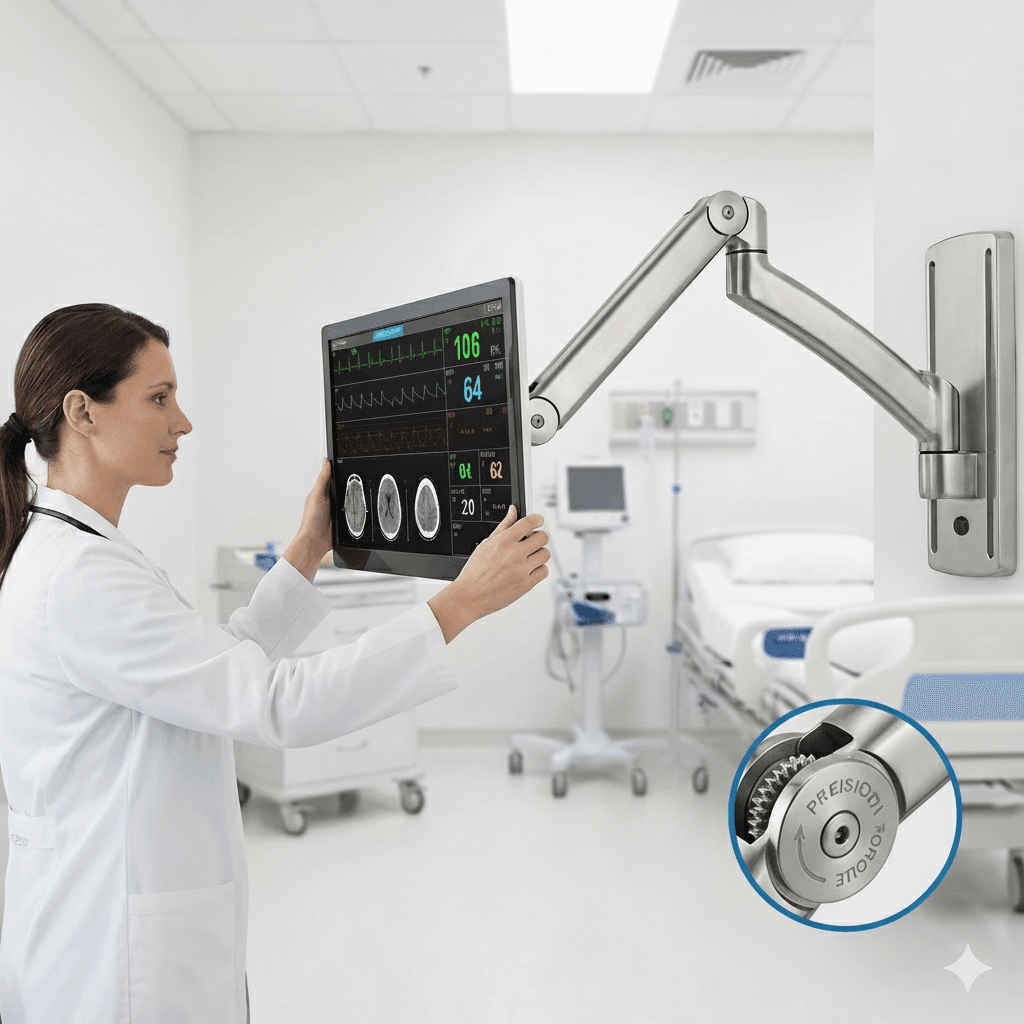

In the demanding fields of healthcare and medical diagnostics, accuracy and reliability are paramount. Healthcare professionals rely on sophisticated equipment to perform critical tasks, and the ergonomic design of this equipment has a significant impact on its efficiency and patient safety. Among the vital components ensuring this precision are friction hinges, engineered to provide stable, adjustable positioning with hand-free mechanisms. At JAN Hinge Damper, we understand that in medical applications, motion control is about securing accuracy.
The Mechanics of Friction Hinges
A friction hinge, also known as a torque hinge or position hinge, is designed to hold a load (such as a screen, monitor arm, or protective cover) at any desired angle throughout its range of motion. Unlike traditional hinges that swing freely, a friction hinge utilizes internal friction elements—often a combination of precision-machined shafts and bands or friction disks—to create a constant resistance against movement.
This resistance counteracts the weight of the connecting components. When the user applies a force exceeding the hinge’s rated torque, the components move smoothly. Once the force is released, the hinge firmly holds the components in place, preventing springback or drift. This “hold-in” feature is crucial in medical environments requiring hands-free operation.
Essential Applications in Healthcare Euipment
The integration of friction hinges into medical equipment enhances both the functionality of the devices and the workflow of medical personnel.
Diagnostic Display Monitors
Modern diagnostic equipment, such as ultrasound machines, MRI consoles, and patient monitoring systems, feature high-resolution displays that must be constantly adjusted for optimal viewing angles. Friction hinges allow doctors and technicians to effortlessly tilt and swivel these heavy monitors with one hand. Once positioned, the screen remains stable, ensuring clear visibility of critical data without glare or shifting.
Surgical Lighting Systems
In the operating room, lighting must be precise and unwavering. Surgical lights mounted on articulating arms rely heavily on high-holding-force torque hinges. These hinges enable surgeons to direct intense illumination exactly where it is needed and trust that the light head will not drift during a delicate procedure.
Hospital Beds and Patient Care Equipment
Adjustable overbed tables, control panels on advanced hospital beds, and articulating arms for patient infotainment systems all utilize friction hinges. They allow patients to adjust their environment comfortably and securely, contributing to a better patient experience and easier caregiving for nurses.
Laboratory and Analytical Instruments
In the laboratory, the protective lids of centrifuges, incubators, and automated analyzers must remain securely open when technicians load and unload samples. Friction hinges prevent these heavy lids from accidentally falling off, thus protecting expensive equipment and the hands of operators from injury.

Engineering for the Medical Environment
Designing friction hinges for medical applications requires meeting stringent requirements far exceeding those of standard industrial use.
Durable and Stable Torque: Medical devices typically have long lifespans and are used frequently. The torque provided by the hinge must remain stable over tens of thousands of cycles. JAN Hinge Damper is dedicated to developing friction hinges that minimize torque decay, ensuring that a monitor bracket remains as stable as on day one after 10,000 cycles.
Hygienic Design and Materials: Devices in medical environments require rigorous cleaning procedures using potent chemicals. Friction hinges must be manufactured from corrosion-resistant materials (such as high-grade 316 stainless steel) or housed in sealed enclosures to prevent contamination and withstand frequent sterilization without rusting or performance degradation.
Smooth and Quiet Operation: A quiet environment is crucial for patient recovery and healthcare staff concentration. The internal mechanics of our torque hinges are carefully designed for quiet operation, avoiding the squeaking or rubbing noises that can occur with inferior components.
| Application | Recommended Hinge Type | Key Requirement |
| Diagnostic Monitor Arm | Medium-duty friction hinge | One-hand adjustability, no drift |
| Surgical Lighting Arm | Heavy-duty position hinge | High holding force, zero creep |
| Portable Diagnostic Tablet | Miniature torque hinge | Compact size, consistent torque |
| Lab Instrument Cover | Standard friction hinge | Corrosion resistance, stay-open |
The JAN Advantage in Medical Motion Control
For medical device manufacturers, choosing the right motion control partner is crucial. Hinge failure is unacceptable in surgical or diagnostic settings.
JAN Hinge Dampers boasts over a decade of R&D experience. We understand that medical applications often require customized solutions. Whether you need a miniature torque hinge for a portable diagnostic tablet or a heavy-duty friction hinge for a large surgical display arm, our engineering team can tailor torque specifications, dimensions, and mounting configurations to your specific needs.
Our commitment to quality is reflected in rigorous lifecycle testing and stringent tolerance control throughout the manufacturing process, ensuring that every friction hinge we deliver meets the demanding standards of the medical industry.
In short, friction hinges are the unsung heroes of modern medical technology. They provide reliable, adjustable, and intervention-free positioning, allowing healthcare professionals to focus on what matters most: patient care.
Developing next-generation medical devices? Let’s talk.
Contact the JAN Engineering Team today for a custom torque evaluation and to request standard or OEM/ODM samples for your project.