
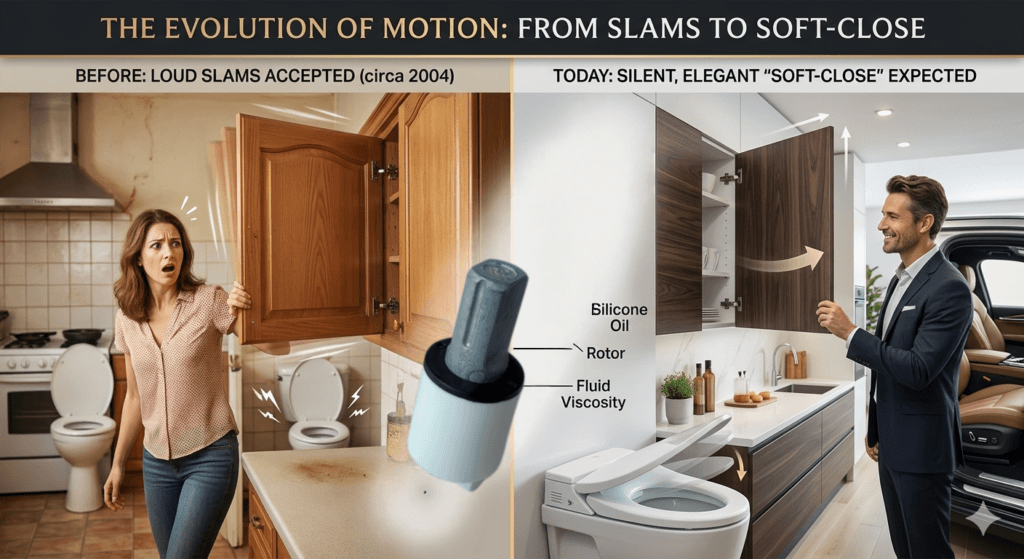
Twenty years ago, a slamming kitchen cabinet door or a dropped toilet seat was simply accepted as a fact of life. Today, a loud slam in a modern home or luxury vehicle is perceived as a sign of poor quality or cheap manufacturing.
The transition from noisy, abrupt mechanical closures to silent, elegant “soft-close” motion represents a massive shift in consumer expectations and industrial design. At the heart of this revolution is a small, often hidden component: the rotary damper.
In this article, we explore how soft-close technology evolved from a luxury novelty into a mandatory standard across multiple industries.
The Early Days: Springs and Rubber Bumpers
Before viscous fluid damping technology became cost-effective, engineers relied on some primitive methods to control movement and prevent damage:
Balance Springs: Heavy-duty metal springs used to counteract the weight of the cover (e.g., from an old car trunk or heavy-duty box). While they made the cover easier to lift, they were dangerous. If the spring broke, the cover would slam down. Furthermore, the springs provided a linear force, which couldn’t smoothly counteract the changing gravitational torque of rotating covers.
Rubber Pads: Small silicone or rubber pads were glued to door frames or covers. They didn’t slow down movement, only reduce impact noise. Kinetic energy was still transferred to the hinges, eventually causing them to break.
The Introduction of Viscous Fluid Damping
The concept of using fluid resistance to absorb energy wasn’t new—automotive shock absorbers have used hydraulic fluid for decades. However, shrinking that technology into a component small enough to fit inside a laptop hinge or a cabinet drawer required significant innovation in materials science and precision manufacturing.
The breakthrough came with the refinement of silicone oil. Unlike mineral oils, high-viscosity silicone oil remains stable across wide temperature ranges and doesn’t degrade plastic housings. This allowed engineers to design compact, sealed rotary dampers that could reliably provide speed-dependent resistance over tens of thousands of cycles.
The Turning Point: The Kitchen Cabinet Revolution
The soft-close revolution truly gained mainstream traction in the early 2000s within the European furniture industry. High-end kitchen manufacturers began integrating tiny rotary dampers into cabinet hinges and drawer slides.
The impact on consumer perception was profound. The silent, controlled glide of a soft-close drawer instantly communicated “premium quality” and “luxury” as well as the safty. It wasn’t just about noise reduction; it was about the tactile feel of the product. The success in the kitchen rapidly spread to other industries.
The Expansion Across Industries
1. Automotive Interiors
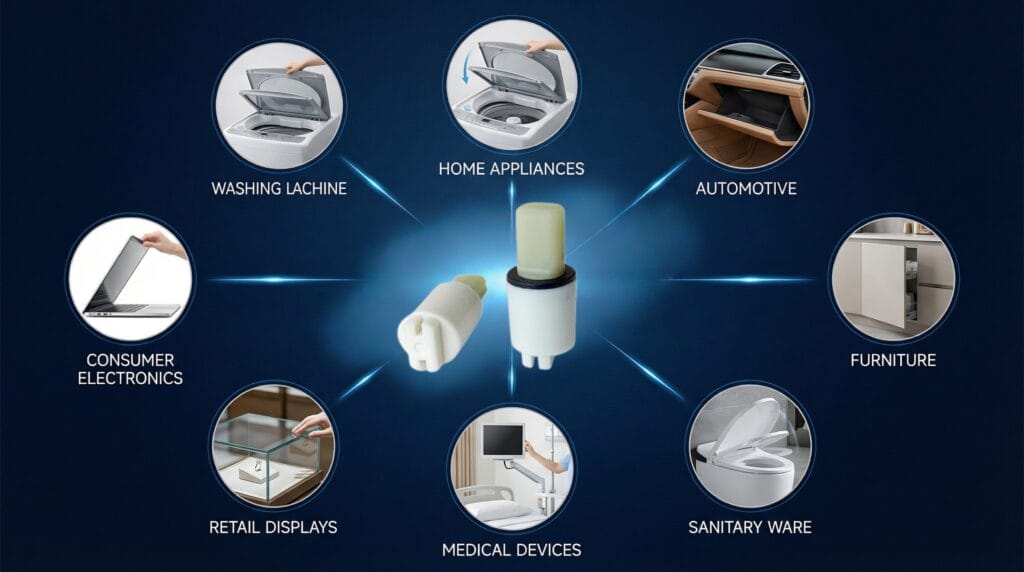
Car manufacturers quickly realized that the “feel” of the interior was just as important as the engine. Rotary dampers were introduced to glove boxes, center console armrests, and overhead grab handles. A glove box that drops open abruptly feels cheap; one that glides open smoothly feels engineered.
2. Sanitary Ware
The slamming toilet seat—a notorious source of midnight noise and broken ceramics—was conquered by the asymmetric vane damper. The ability to lift the seat easily but have it close slowly and silently became a standard feature in mid-to-high-end bathrooms globally.
3. Home Appliances
Washing machine manufacturers faced a challenge: as machines grew larger, so did their heavy glass lids. A slamming lid was a severe safety hazard (pinched fingers) and a warranty nightmare (shattered glass). Heavy-duty rotary dampers solved both problems, becoming standard on top-load washers.
4. Consumer Electronics
As laptops and tablets became thinner, the demand for smooth, precise screen positioning grew. Micro-dampers and high-precision friction hinges replaced crude friction washers, allowing users to open a laptop with one hand and position the screen perfectly without wobble.
The Future of Soft-Close: Miniaturization and Integration
Today, soft-close technology is no longer a luxury differentiator; it is a baseline expectation. If a product moves, consumers expect it to move smoothly.
The future of rotary damper technology lies in two areas:
1.Miniaturization: As IoT devices, smart home cameras, and wearables shrink, manufacturers like JAN Hinge Damper are developing ultra-micro gear dampers (as small as 5mm) to provide motion control in incredibly tight spaces.
2.Hidden Integration: Designers want the benefits of soft-close without seeing the mechanism. Dampers are increasingly being integrated directly into the pivot point of the hinge itself, creating a seamless, invisible user experience.
Frequently Asked Questions (FAQ)
Q1: Did soft-close technology originate in the automotive or furniture industry?
A: While fluid damping has roots in heavy industry and automotive suspensions, the widespread consumer adoption of micro rotary dampers for tactile “soft-close” feel was heavily driven by the European high-end kitchen cabinet industry in the late 1990s and early 2000s.
Q2: Why do some cheap soft-close products fail quickly?
A: Cheap dampers often use low-quality plastics that crack under pressure, or inferior silicone oil that shears down and loses viscosity after a few thousand cycles. They also frequently lack proper ultrasonic welding, leading to oil leaks.
Q3: Can a rotary damper replace a gas spring?
A: In some applications, yes. A heavy lid that previously used a gas spring to prevent slamming can often be redesigned with a high-torque rotary damper, which is smaller, cheaper, and less prone to sudden catastrophic failure than a pressurized gas strut.
Q4: Is the soft-close trend slowing down?
A: No, it is expanding. As consumers become accustomed to silent motion in their homes and cars, they are demanding it in commercial spaces, medical equipment, retail displays, and even industrial machinery.
Q5: How does JAN Hinge Damper stay ahead of these trends? Talk more on Whatsapp
A: By investing heavily in R&D, automated precision manufacturing, and custom engineering. We work directly with OEMs to design dampers that fit the specific ergonomic and space requirements of next-generation products.