
When designing a product that requires a lid, screen, or door to stay open at a precise angle without falling, engineers face a critical challenge. Relying on gas struts, mechanical catches, or support arms often adds unnecessary bulk, assembly complexity, and cost to the final design. The most elegant and reliable solution is integrating friction hinges directly into the product architecture.
Also known in the industry as torque hinges or position control hinges, these specialized mechanical components use internal resistance to hold panels securely at any desired angle — without any additional support hardware. They create a seamless “free-stop” mechanism that dramatically improves the user experience and elevates perceived product quality. Whether you are developing a premium laptop, a heavy-duty industrial control panel, or a medical diagnostic display arm, understanding how to select the right friction hinge is one of the most important engineering decisions you will make.
In this comprehensive buyer’s guide, we will break down the mechanics behind constant torque hinges, compare the four primary types available on the market, review key industry applications, and provide actionable guidance on how to evaluate a friction hinge manufacturer for your next OEM project.
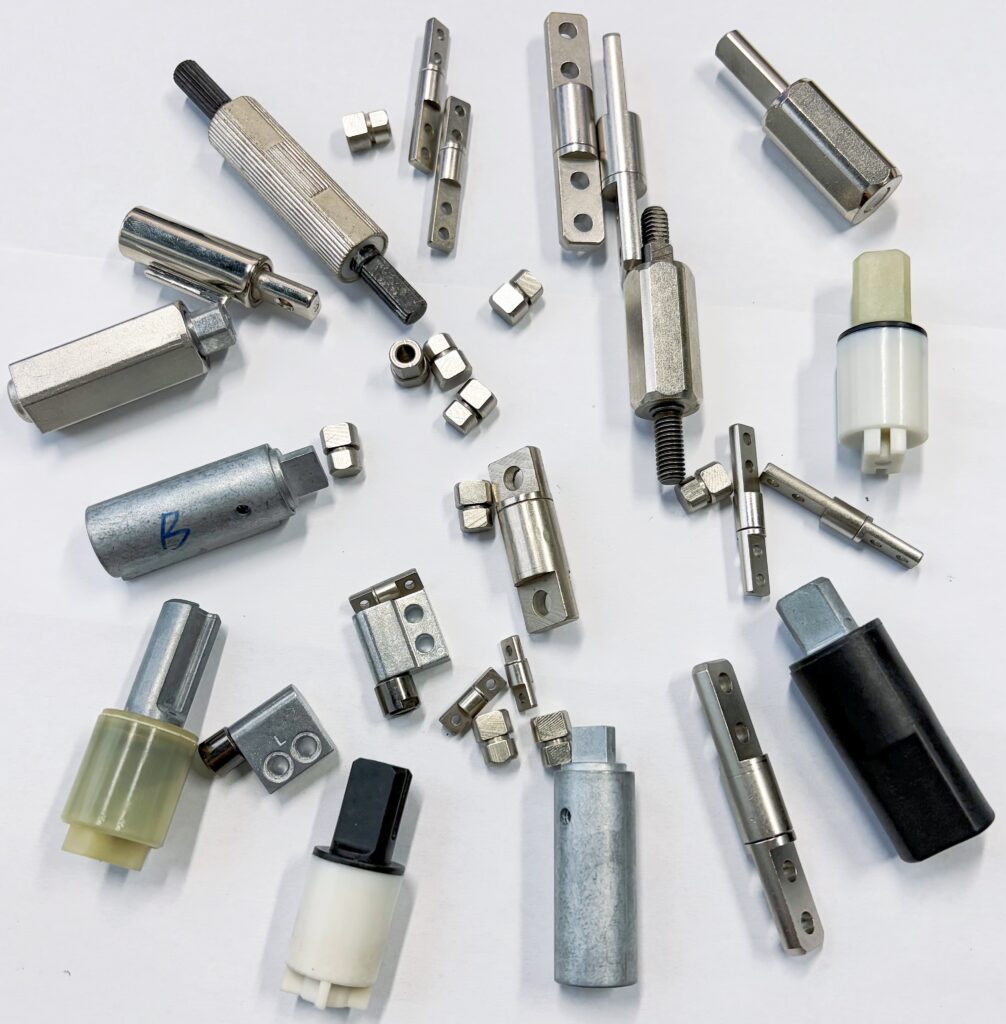
JAN Precision Friction Hinges — engineered for consistent torque across 50,000+ cycles.
How Do Friction Hinges Work? The Mechanics of Position Control
At its core, a friction hinge operates on the principle of controlled mechanical resistance. Unlike traditional free-swinging hinges that rely entirely on gravity and external latches, a torque hinge is engineered to generate a specific, calibrated amount of rotational friction — measured in Newton-meters (Nm) or kilogram-force centimeters (kgf·cm).
This internal resistance is typically achieved through precisely designed internal components. The most common design involves tightly winding a hardened steel spring clip or band around a central metal shaft. As the hinge rotates, the friction between the spring band and the shaft generates a constant torque that counteracts the weight of the connected panel. To ensure smooth and long-lasting operation, high-quality manufacturers use proprietary high-viscosity synthetic lubricants within the components.
The main advantage of this mechanism is that it achieves a truly constant torque hinge. The resistance remains uniform throughout the entire range of motion from 0° to 360°, allowing the user to open a heavy door with minimal force and hold it at any angle. When the applied torque is properly matched to the weight of the panel, the door can remain in its position indefinitely without shifting—a pattern known in the industry as torque decay.
The 4 Main Types of Friction Hinges for OEM Applications
Not all friction hinges are made the same. Depending on your load requirements, space constraints, and the desired user interaction, these four primary types to consider. Selecting the correct type is the foundational step in ensuring long-term product reliability.
Constant Torque Hinges (Symmetric) provide the exact same amount of resistance in both the opening and closing directions. These are the standard choice for industrial enclosures, heavy-duty equipment cabinets, and adjustable monitor arms where the user expects a uniform, predictable feel regardless of which direction the panel is moved. They are the most widely specified type in B2B OEM procurement.
Asymmetric Torque Hinges (Differential Friction) are engineered to provide high resistance in one direction and lower resistance in the other. This design is what enables the premium “one-handed open” experience on high-end laptops: the hinge provides enough holding force to keep the screen upright against gravity, yet releases easily when the user closes the lid. This type requires precise engineering and is typically sourced from specialized torque hinge manufacturers.
Adjustable Friction Hinges feature a small tension screw that allows the end user or installer to manually increase or decrease the internal friction after installation. They are ideal for applications where the exact panel weight may vary between configurations, such as custom mounting brackets, adjustable lighting fixtures, or aftermarket automotive accessories. The ability to fine-tune the torque on-site adds significant flexibility to the product design.
Detent Hinges incorporate a mechanical cam profile that causes the hinge to “click” and lock into pre-defined angles (such as 90°, 120°, or 135°). While not a free-stop friction hinge in the traditional sense, they are widely used in tablet kickstands, foldable appliances, and professional display stands where precise, repeatable positioning at specific ergonomic angles is required.

Selecting the correct torque (Nm) is critical. Always account for the panel’s weight and center-of-gravity distance from the hinge pivot.
Industry Applications: Where Position Control Defines Product Quality
The versatility of friction hinges makes them indispensable across a wide range of industries. By integrating these components, product designers can streamline their hardware architecture, reduce part count, and deliver a premium tactile experience that customers associate with quality.
| Industry Sector | Common Applications | Key Hinge Requirements |
| Consumer Electronics | Laptop screens, 2-in-1 tablets, foldable monitors | Miniature profile, asymmetric torque, zero spring-back, 30,000–50,000 cycle life |
| Medical Equipment | Diagnostic display arms, surgical lighting, hospital bed rails | High holding force, stainless steel construction, precise constant torque |
| Industrial & Automation | Machine safety guards, HMI control panels, heavy enclosures | Heavy-duty build, vibration resistance, wide temperature range |
| Automotive & Aerospace | Center consoles, glove boxes, overhead storage compartments | Smooth operation, vibration dampening, lightweight alloy materials |
| Marine & RV | Hatch covers, livewell lids, exterior storage compartments | 316 stainless steel, extreme corrosion resistance, high load capacity |
| Furniture & Architecture | Adjustable desks, display cases, cabinet lids | Aesthetic finish, quiet operation, mid-range torque |

JAN friction hinges serve six major industries — from consumer electronics to heavy-duty marine and industrial applications.
How to Evaluate a Friction Hinge Manufacturer: 4 Critical Criteria
When sourcing torque hinges for a new product line, the basic torque figure on a datasheet is only the starting point. To avoid costly redesigns, field failures, and warranty claims, OEM procurement teams must interrogate potential suppliers on four critical performance dimensions.
1. Cycle Life and Torque Retention Data. This is the single most important metric. A low-quality hinge may start with adequate resistance but suffer a 40% drop in torque after just 5,000 cycles, causing screens and lids to flop. A credible manufacturer will provide actual test reports showing that torque retention remains above 85% after 30,000 to 50,000 cycles. Do not accept verbal assurances — request the documented test curve. At JAN Hinge, all friction hinge designs are validated through continuous in-house lifecycle testing before mass production.
2. Environmental Durability and Material Specification. Consider the operating environment. For marine, outdoor, or food-processing applications, standard carbon steel is unacceptable; 304 or 316 stainless steel is mandatory. For high-temperature environments such as automotive interiors or industrial ovens, the internal lubricants must be rated for the full operating temperature range. Always request a material certificate and a temperature specification from your supplier.
3. Customization Speed and Engineering Support. Off-the-shelf hinges rarely fit perfectly into highly engineered, compact devices. Partnering with a manufacturer who offers rapid prototyping, custom torque calibration, and in-house mold development can dramatically accelerate your time-to-market. JAN’s engineering team provides custom 3D design proposals within 7 business days and can deliver functional OEM samples within 20 days — a critical advantage when development timelines are tight.
4. Quality Certifications and Process Control. For regulated industries such as medical devices and automotive components, supplier certifications are non-negotiable. Look for manufacturers holding ISO 9001, ISO 14001, and ideally IATF 16949 certifications. These standards ensure that every batch of friction hinges you receive meets the same dimensional and torque tolerances as the samples you approved.
Conclusion: Choosing the Right Friction Hinge is a Brand Decision
Integrating the right friction hinge into your product design does more than hold a door open — it defines the physical interaction your customer has with your brand every single day. From the satisfying, smooth resistance of a premium laptop screen to the rugged reliability of an industrial control panel, torque hinges are the silent workhorses of modern product design.
By understanding the differences between constant, asymmetric, and adjustable friction hinges, and by partnering with a verified manufacturer who can provide documented torque retention data and rapid custom samples, you can ensure your next project delivers flawless position control from day one.
Ready to find the right friction hinge for your application? Contact the JAN engineering team for a free technical consultation and custom torque specification — response within 4 hours guaranteed. Or know more on Whatsapp.
Frequently Asked Questions About Friction Hinges
FAQ 1: What is the difference between a friction hinge and a regular hinge?
A standard hinge allows a door or panel to swing freely, relying on external latches, gas struts, or support arms to hold it in a specific position. A friction hinge (also called a torque hinge or position control hinge) contains internal resistance mechanisms — typically spring steel bands or friction discs — that allow the panel to hold its position at any angle without any additional hardware. This eliminates the need for separate stays or gas shocks, simplifying the overall product design.
FAQ 2: How do I calculate the correct torque for my friction hinge?
To calculate the required torque, you need two values: the weight of the panel (in kg or lbs) and the distance from the hinge pivot point to the panel’s center of gravity (in meters or inches). The basic formula is: Torque (Nm) = Weight (N) × Distance to Center of Gravity (m). It is strongly recommended to add a 20–30% safety margin to account for real-world variables such as vibration, temperature changes, and manufacturing tolerances. For complex applications, JAN’s engineering team can perform the torque calculation for you at no charge.
FAQ 3: How long do friction hinges last before losing their resistance?
The lifespan depends heavily on the quality of materials and manufacturing precision. Premium friction hinges from reputable manufacturers are engineered to endure 30,000 to 50,000 open-close cycles with less than a 15% reduction in torque. Lower-quality hinges using inferior spring steel or cheap lubricants may experience significant torque decay after just 5,000 to 10,000 cycles, causing the panel to drift or fall. Always request a documented torque decay test report before approving a supplier.
FAQ 4: Can you adjust a friction hinge after it has been installed?
It depends on the specific model. Constant torque hinges have their resistance permanently set at the factory and cannot be changed after installation. Adjustable friction hinges, however, feature a small tension screw that allows the user to increase or decrease the friction level using an Allen wrench or standard screwdriver. If your application requires the ability to fine-tune the resistance in the field, specifying an adjustable model from the outset is the correct approach.
FAQ 5: Why is my laptop screen slowly falling backward or forward?
When a laptop screen gradually drifts from its set position, it is experiencing torque decay — the most common failure mode for friction hinges. This occurs when the internal spring steel bands or friction discs within the hinge assembly wear down over time, losing their ability to generate sufficient resistance to counteract the weight of the display panel. The root cause is typically low-quality materials or insufficient lubrication in the original hinge. The only permanent solution is to replace the hinge assembly with a higher-quality unit. For OEM manufacturers, this is a preventable issue by specifying hinges with verified long-cycle-life test data.
For more technical resources on motion control components, explore the JAN Hinge Blog or visit our Friction Hinges product page to browse our full range of standard and custom torque hinges.