
If you have ever lifted a high-end toilet seat, you probably noticed something interesting: it lifts effortlessly, almost as if it has no weight at all. But when you let it go, it doesn’t slam down. Instead, it slowly and silently glides to a close.
This seemingly contradictory behavior—easy to open, hard to close—is not magic. It is the result of a brilliant piece of mechanical engineering known as asymmetric damping, or uni-directional damping.

Cutaway view of a uni-directional rotary damper: the one-way clutch engages in the damping direction (orange) and idles freely in the return direction (green).
In the world of motion control and mechanical design, ensuring smooth, controlled movement is paramount. Whether it is a heavy industrial lid, a delicate keyboard cover, or a retractable projector screen, the way an object moves dictates its safety, longevity, and user experience. While standard rotary dampers provide resistance in both directions, many applications require a more sophisticated approach: Asymmetric or Uni-directional Damping.
For design engineers and procurement professionals, understanding the mechanics, advantages, and applications of asymmetric damping is crucial for selecting the right components for premium product designs. This article explores the principles behind uni-directional rotary dampers and why they are essential in modern engineering.
Understanding Asymmetric (Uni-directional) Damping
Asymmetric damping, commonly referred to as uni-directional damping or one-way damping, is a mechanical feature where a damper provides significant resistance (damping torque) in one direction of motion, while allowing nearly free, unresisted movement in the opposite direction.
In a standard bi-directional rotary damper, the internal rotor agitates highly viscous silicone oil regardless of which way the shaft turns. This means the user must overcome the damping force both when opening and closing a lid — an ergonomic compromise that is unacceptable in premium consumer products. Conversely, a uni-directional rotary damper is engineered to engage the damping fluid only when rotating in the designated direction. When reversed, the mechanism “freewheels,” allowing the user or a spring mechanism to move the application with minimal effort.
How Does a Uni-directional Rotary Damper Work?
The secret to asymmetric damping lies in the internal architecture of the rotary damper, specifically the integration of a one-way clutch or a specialized vane mechanism.
The One-Way Clutch Mechanism
In continuous rotation dampers, a one-way clutch (often a sprag or roller clutch) is built directly into the rotor or shaft assembly. When the shaft is rotated in the “active” direction, the clutch locks, forcing the rotor to turn through the viscous silicone oil. This generates shear resistance and provides a smooth, controlled motion. When the rotation is reversed, the clutch disengages and idles. The shaft spins freely without turning the rotor, meaning no fluid shear occurs and the torque drops to near zero.
The Vane Mechanism
In partial rotation angle dampers (often used in toilet seats or heavy lids), the damper uses a vane that sweeps through a sealed chamber of oil. These vanes are designed with specialized bypass valves or asymmetrical profiles. In the damping direction, the valve closes, forcing oil through a tiny orifice to create high resistance. In the return direction, the valve opens, allowing the oil to flow freely past the vane, resulting in minimal resistance.
Asymmetric vs. Symmetric: A Visual Comparison
The chart below clearly illustrates the fundamental difference between the two damping approaches. In a symmetric (bi-directional) damper, the user experiences equal resistance in both directions. In an asymmetric (uni-directional) damper, the torque profile is entirely different: high resistance in one direction, near-zero in the other.

Torque profile comparison: A symmetric damper resists in both directions (left), while an asymmetric damper provides high torque only in the damping direction (right).
Key Advantages of Asymmetric Damping
Engineers specify uni-directional dampers because they solve specific ergonomic and mechanical challenges that bi-directional dampers cannot.
Superior Ergonomics and User Experience is the primary advantage. There is no loss of operability in the “free” direction. When lifting a heavy shutter or a piano keyboard cover, the user only lifts the actual weight of the object. The damper does not add unnecessary resistance during the opening phase. However, when the user lets go, the clutch engages instantly, and the object lowers slowly and safely.
Instantaneous Response is another critical benefit. High-quality one-way clutches have excellent locking response. If a user’s hand slips while lifting a heavy lid, the rotation direction changes instantly. The clutch locks without delay, generating immediate damping torque to prevent the lid from slamming shut and causing injury.
Simplified Assembly and Mounting is a practical advantage for production lines. Mounting a bi-directional damper with engaging gears can be difficult, as the shaft must be turned against the strong damping force to align the gear teeth. With a one-way rotary damper, the installer can easily spin the gear by hand in the free-wheeling direction to perfectly align it, significantly speeding up the assembly process.
Common Applications
Uni-directional rotary dampers are ubiquitous in applications where gravity or spring tension acts in one direction, and manual human effort acts in the other.
| Application | The Damping Direction | The Free Direction | Key Benefit |
| Piano / Keyboard Covers | Closing (Gravity) | Opening (Manual lift) | Prevents finger slamming; light to open |
| Washing Machine Lids | Closing (Gravity) | Opening (Manual lift) | Soft-close safety; no extra effort to open |
| Rolling Shutters / Blinds | Lowering (Gravity) | Raising (Manual) | Controlled descent; standard lifting force |
| Steel Tape Measures | Retracting (Spring) | Pulling out (Manual) | Prevents tape whipping back; easy to extend |
| Sliding Cabinet Doors | Closing | Opening | Reduces impact noise; standard opening force |
| Projector Screens | Retracting (Spring) | Pulling down (Manual) | Smooth retraction; easy to deploy |

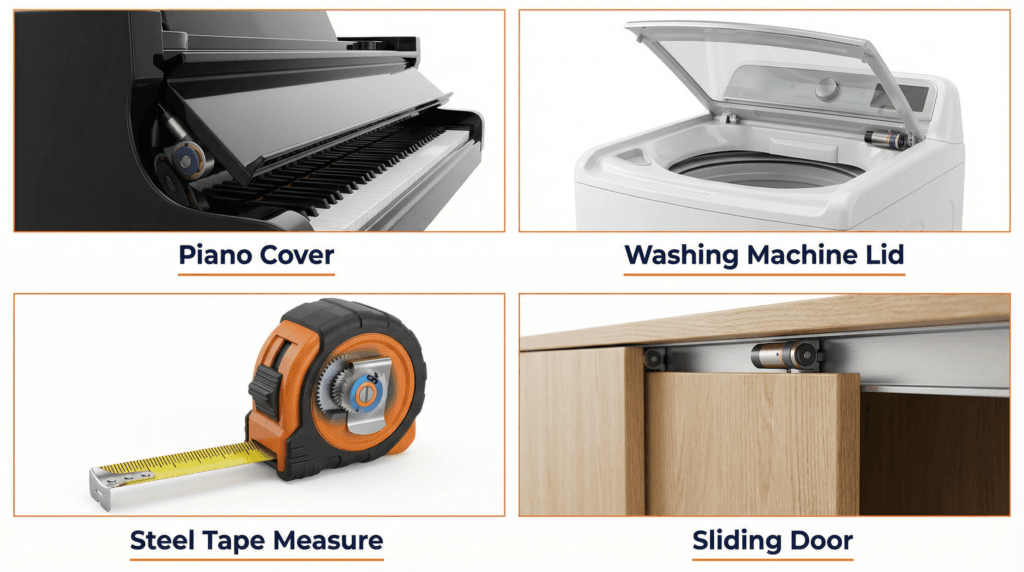
Typical applications of uni-directional rotary dampers: piano covers, washing machine lids, tape measures, and sliding doors all benefit from asymmetric damping.
Application Torque Profile at a Glance
The chart below visualizes how dramatically different the damping force is between the active and free directions across all major application categories.

In every application, the damper provides high resistance in the gravity/spring direction while allowing near-zero resistance for manual operation.
Specifying the Right Damper
When procuring a one-way rotary damper, it is critical to specify the correct damping direction (CW or CCW) relative to how the damper will be mounted in your assembly. Engineers must also account for the fact that continuous rotation one-way dampers often require a slightly larger outer diameter to accommodate the internal clutch while maintaining the same torque output as a standard damper.
At Janhinge, we specialize in both continuous and limited-angle uni-directional rotary dampers. Our engineering team can help you calculate the exact torque requirements and select the optimal asymmetric damping profile for your specific application.
Request a Custom Uni-directional Damper Solution → OR Talk on Whatsapp
Frequently Asked Questions (FAQ)
Q1: What happens if I install a uni-directional damper backward?
If installed backward, the damper will provide resistance when you want free movement (e.g., making a lid very hard to open) and will freewheel when you need damping (causing the lid to slam shut). It is critical to verify the CW or CCW specification against your assembly drawing before installation. Most manufacturers mark the damping direction on the housing.
Q2: Are one-way dampers more expensive than two-way dampers?
Generally, yes. Because uni-directional dampers require additional internal components — such as a precision one-way sprag clutch or complex valving — their manufacturing cost is slightly higher. However, the ergonomic and safety benefits typically far outweigh the cost difference in premium consumer products, where user experience is a key differentiator.
Q3: Can a one-way damper provide zero resistance in the free direction?
It provides near-zero resistance. There is always a microscopic amount of mechanical friction from the idling clutch or seals, but it is typically negligible and imperceptible to the end-user. For most engineering calculations, the free-direction torque can be treated as zero.
Q4: Do uni-directional dampers wear out faster because of the clutch?
High-quality one-way rotary dampers are designed for longevity, typically rated for tens of thousands of cycles. The clutches are precision-engineered to withstand repeated engagement and disengagement. In fact, because the damper only actively agitates the viscous oil in one direction, the thermal and mechanical load on the silicone oil can be lower than in a heavily used bi-directional damper.
Q5: How do I know if I need a continuous rotation or a limited-angle one-way damper?
It depends on your application’s range of motion. If your application rotates less than approximately 110 degrees (like a toilet seat, a standard lid, or a flip-top container), a limited-angle vane damper is ideal as it provides high torque in a compact size. If the application rotates 360 degrees or multiple turns (like a rolling shutter, a retractable cord, or a tape measure), you must use a continuous rotation damper with an internal one-way clutch.
Have a specific engineering challenge? Contact the Janhinge technical team at [email protected] or visit www.janhinge.com for custom rotary damper solutions.