
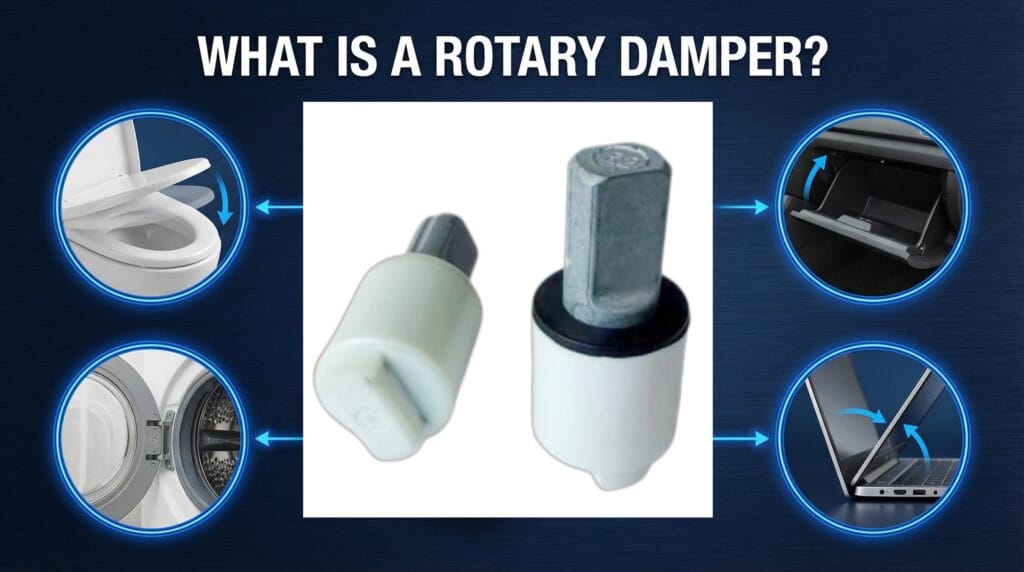
In product design and mechanical engineering, controlling motion is just as important as creating motion. A lid slamming shut, a drawer slamming against a frame, or a delicate dashboard suddenly falling not only creates a poor user experience but can also damage the product. This is where rotary dampers come in handy.
A rotary damper is a small, often imperceptible mechanical component that absorbs kinetic energy, thereby slowing and controlling rotational motion. It’s responsible for the “gentle closure” of a high-end piano lid, the smooth opening of a car glove box, and the quiet operation of a modern washing machine cover.
For product engineers and purchasing managers looking to enhance the perceived value of their products and extend their lifespan, understanding how rotary dampers work, their different types, and how to choose the right one is crucial. This guide, crafted by JAN Hinge Damper‘s team of engineering experts, will take you deep into the technical principles of rotary dampers.
How Does a Rotary Damper Work?
The fundamental principle behind almost all rotary dampers is viscous fluid resistance.
Inside the sealed housing of a rotary damper is a cavity filled with a highly viscous fluid, typically a specialized silicone oil. When an external force is applied to the damper’s shaft (e.g., gravity pulling a lid down), a rotor or vane attached to that shaft begins to turn inside the oil-filled cavity.
Because the silicone oil is thick and resistant to flow, it creates friction (drag) against the moving rotor. The rotor is designed with specific clearances—tiny gaps between the rotor and the housing. As the rotor turns, it forces the silicone oil through these narrow clearances. The energy required to shear the oil and force it through the gaps converts the kinetic energy of the moving object into a tiny amount of heat, which dissipates through the housing.
The result is a smooth, controlled, and continuous deceleration of the moving part. The faster the rotational speed, the greater the resistance generated by the fluid, which naturally prevents sudden drops or slams.

Main Types of Rotary Dampers
While the underlying principle is the same, rotary dampers come in several distinct designs to accommodate different torque requirements, space constraints, and ranges of motion.
1. Vane Dampers
Vane dampers are the most common type for applications requiring high torque over a limited range of motion.
•Mechanism: A vane (like a paddle) is attached to the central shaft. As the shaft rotates, the vane sweeps through the silicone oil chamber.
•Range of Motion: Typically limited to an angle of 110° to 180°.
•Applications: Toilet seats, piano lids, washing machine doors, heavy display cases.
•Advantage: Can generate very high damping torque in a relatively compact size. They can also be designed to be “asymmetric,” meaning they provide strong resistance in one direction (closing) and almost no resistance in the other (opening).
2. Gear Dampers
Gear dampers are designed for applications requiring continuous, 360-degree rotation.
•Mechanism: A gear is attached to the rotor shaft, which meshes with a gear rack or another gear on the moving part. As the external gear turns the damper’s gear, the internal rotor spins in the silicone oil.
•Range of Motion: Continuous 360° rotation.
•Applications: CD/DVD player trays, automotive cup holders, retractable handles, small sliding drawers.
•Advantage: Highly versatile for continuous motion. They are generally smaller and produce lower torque than vane dampers, making them ideal for lightweight consumer electronics and automotive interiors.
3. Disk Dampers
Disk dampers (or barrel dampers) are used when moderate torque is needed in a very slim profile.
•Mechanism: One or more flat disks rotate closely against stationary plates, with silicone oil trapped between them.
•Range of Motion: Continuous 360° rotation.
•Applications: Medical equipment hinges, specialized seating, theater folding chairs.
•Advantage: Extremely low profile, allowing them to be integrated into tight spaces where a cylindrical damper would not fit.
Why Use Silicone Oil?
You might wonder why water or standard machine oil isn’t used. Silicone oil is the industry standard for high-quality rotary dampers for three critical reasons:
1.Temperature Stability: Silicone oil has an exceptionally flat viscosity-temperature curve. This means it maintains a relatively consistent thickness whether it’s in a freezing car interior (-20°C) or a hot industrial environment (60°C). If standard oil were used, a soft-close lid would slam shut in the summer and freeze solid in the winter.
2.Chemical Inertness: It does not react with the plastic or zinc alloy housings, ensuring the damper does not degrade internally over time.
3.High Shear Strength: It can withstand the intense shearing forces generated inside the damper for tens of thousands of cycles without breaking down and losing its viscosity.
Key Engineering Specifications for Selection
When selecting a rotary damper for an OEM project, engineers must consider several critical parameters:
| Specification | Description | Importance |
| Damping Torque (N·m or kgf·cm) | The amount of resistance the damper provides. | Must be matched precisely to the weight and center of gravity of the moving part. Too little torque = slamming. Too much = the lid won’t close fully. |
| Damping Direction | Clockwise (CW), Counter-Clockwise (CCW), or Bi-directional. | Determines if the object is damped when opening, closing, or both. |
| Operating Temperature | The ambient temperature range the damper can withstand. | Crucial for automotive or outdoor applications. |
| Lifecycle | The number of full cycles the damper can perform before torque drops below a specified percentage. | Determines the longevity of the soft-close feature. High-quality dampers exceed 50,000 to 100,000 cycles. |
| Material | Housing material (POM, PC, Zinc Alloy). | Dictates the physical strength and abuse resistance of the damper. |
The Value of Motion Control
Integrating a rotary damper into a product is rarely about basic functionality—a lid will close with or without one. Instead, it is about user experience, safety, and perceived quality.
A product that utilizes controlled motion feels heavier, more substantial, and better engineered. It prevents pinched fingers in children’s furniture and protects delicate glass in retail displays. For procurement managers, sourcing reliable rotary dampers from a specialized manufacturer like JAN Hinge Damper is a low-cost method to significantly elevate the premium positioning of the final product.
Frequently Asked Questions (FAQ)
Q1: How do I calculate the required torque for my application?
A: The basic formula for a pivoting lid is Torque (T) = Weight (W) × Distance to Center of Gravity (L) × cos(θ). However, this is only the static torque. You must also account for dynamic forces and safety margins. We highly recommend consulting with JAN Hinge Damper’s engineering team with your CAD drawings for precise torque calculation and model selection.
Q2: What is the difference between a rotary damper and a friction hinge?
A: A rotary damper uses fluid resistance to slow down motion (it provides dynamic resistance). If you let go of a damped lid, it will eventually close. A friction hinge (torque hinge) uses mechanical friction to hold an object in place (it provides static resistance). If you let go of a screen on a friction hinge, it stays exactly where you left it.
Q3: Can rotary dampers leak oil?
A: Low-quality dampers are prone to leaking, especially under stress or high temperatures. JAN Hinge Damper utilizes advanced ultrasonic welding for plastic housings and dual O-ring seals for metal housings to ensure zero leakage over the product’s lifespan, even under abuse conditions.
Q4: What happens if someone forces a soft-close lid shut?
A: If a user pushes down hard on a damped lid, the pressure inside the silicone oil chamber spikes. Standard dampers may crack or blow their seals. For applications prone to abuse, we engineer dampers with internal pressure-relief (overload) valves that temporarily bypass the fluid, protecting the damper from catastrophic failure.
Q5: Can I get a custom damper size or torque profile?
A: Yes. While we offer a vast catalog of standard dampers, a significant portion of our business is custom OEM development. We can customize the housing dimensions, shaft type, gear profile, and exact torque rating to seamlessly integrate into your specific product design.
Ready to elevate your product’s motion control? Let’s talk in Whatsapp
Contact the JAN Engineering Team today to request samples, discuss custom torque calculations, and find the perfect rotary damper for your next project.