
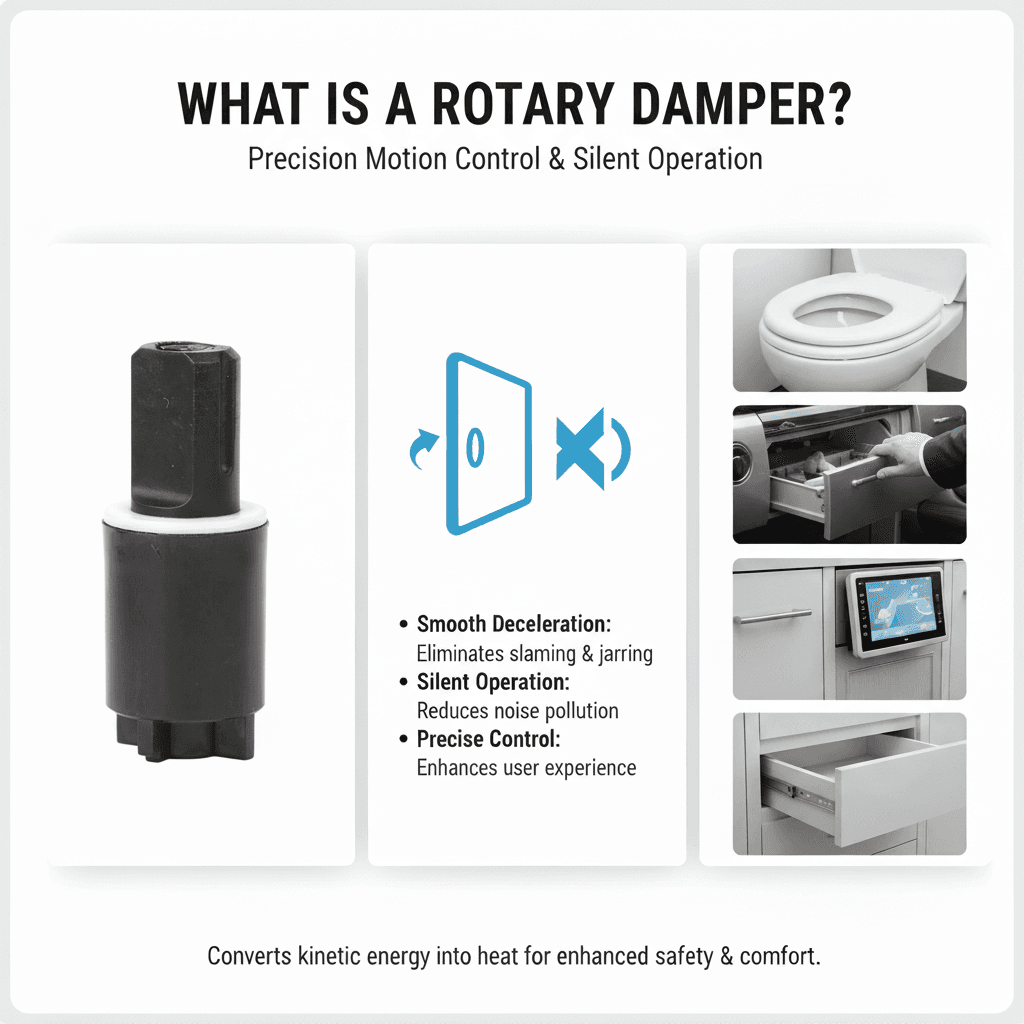
In high-end product manufacturing, the perception of quality is often defined by how a product moves. Whether it is the silent, controlled descent of a washing machine lid or the fluid resistance of an automotive glove box, these tactile interactions define brand equity.
At the heart of soft close motion control is the Rotary Damper. For product engineers, it is a tool for kinetic energy management; for procurement leads, it is a strategic component that reduces mechanical wear and elevates market positioning.
1. Technical Fundamentals: Why Damping Transcends Friction
To specify the right component, one must distinguish between Friction hinges and Viscous Damping.
- Mechanical Friction: Relies on surface-to-surface interference. It is prone to stiction (start-stop jerkiness), surface wear, and significant torque drop-off over time.
- Viscous Damping: Utilizes fluid shear stress. By using high-viscosity silicone oil, the damper converts kinetic energy into thermal energy.
The Physics of Control: In a rotary damper, the resistance is proportional to the angular velocity. The faster the movement, the higher the resistance. This non-linear feedback provides a “silk-smooth” user experience that mechanical friction cannot replicate.
2. The Mechanics of Motion Control: How It Works
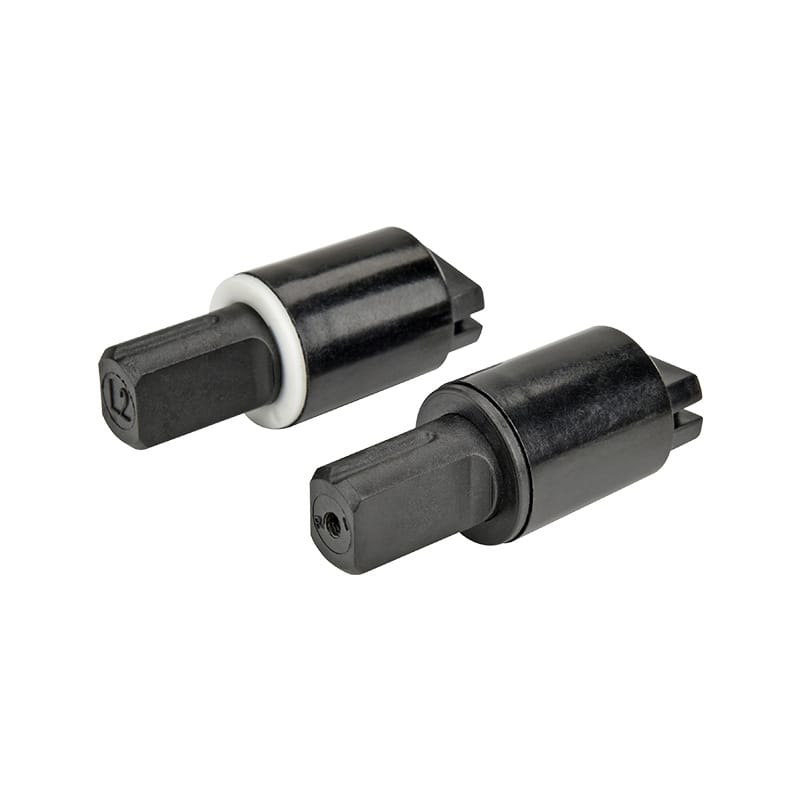
A professional-grade rotary damper consists of a Rotor, a Stator (Housing), and a Damping Medium (Silicone Oil).
Temperature Stability: The Silicone Advantage
In industrial applications, environmental consistency is non-negotiable. Standard oils fluctuate in viscosity with temperature. JAN uses specialized silicone fluids with an Ultra-High Viscosity Index, ensuring stable torque performance from -40°C to +90°C. Whether your product is in the Arctic or the Sahara, the “feel” remains identical.
3. Rotary Damper Classification by Motion: Selecting the Right Architecture
When sourcing dampers for a new project, engineers must choose the architecture that matches their mechanical requirements.
| Type | Mechanism | Primary Advantage | Typical Torque Range |
| Vane Dampers | Limited rotation (usually <180°) | High torque in a compact flat profile. | 1.0Nm- 10.0Nm |
| Gear Dampers | Continuous 360° rotation | Easy integration with racks or spur gears. | 2 – 5Ncm |
| Disk Dampers | High surface area contact | Extremely high torque for heavy lids. | Up to 40 Nm |
| Barrel Dampers | Cylindrical design | Fits directly into hinge axes. | 0.5Nm- 3.0 Nm |
4. Rotary Damper Strategic Application Fields
4.1 Automotive Interiors & Architecture
Automotive OEMs demand “Zero BSR” (Buzz, Squeak, Rattle) performance.
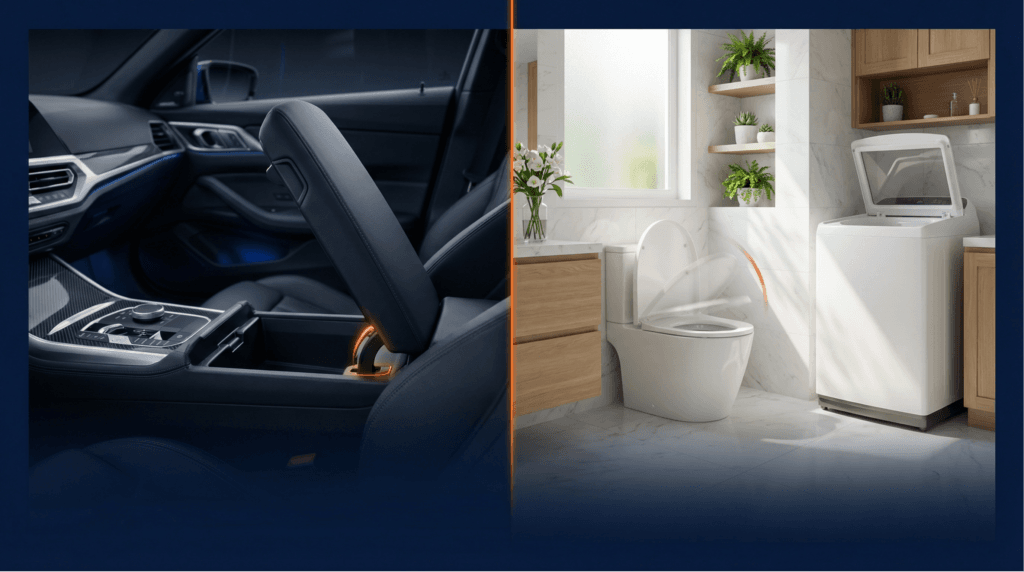
- Grab Handles: One-way dampers ensure the handle retracts silently without striking the headliner.
- EV Charging Ports: Protects the motorized actuators from inertial shock during deployment.
- Center Consoles: Provides the “hydraulic feel” expected in luxury segments.
4.2 Premium Home Appliances
Safety and longevity are the primary drivers in the “White Goods” sector.
- Soft-Close Washers: For heavy tempered glass lids ($3\text{kg} – 5\text{kg}$), vane dampers provide high torque (up to $10\text{ Nm}$) to prevent slamming, protecting both the user’s hands and the machine’s structural integrity.
- Built-in Ovens: Ensures controlled door deployment, preventing hinge fatigue.
4.3 Medical & Lab Equipment
In sterile or sensitive environments, vibration is the enemy.
- Medical Carts: Dampers allow for smooth tilting of monitor arms, preventing screens from dropping due to gravity.
- Centrifuge Lids: Ensures even pressure on gaskets during closure, maintaining a perfect seal.
4.4 Furniture & Commercial Hardware
- Cable Management: Pop-up socket boxes in conference tables use gear dampers to eliminate the “metallic snap,” maintaining a professional atmosphere.
How do I choose the correct torque for my application?
Torque is calculated based on the lid’s weight L, length H, and the gravity angle (alpha). The formula is T = L *(H/2) *cos(alpha) * 9.8. We recommend selecting a damper with a rated torque 10% – 20% higher than your peak calculated torque to ensure a consistent “soft-close” effect even as mechanical friction changes over time.
How does extreme temperature affect performance?
We use high-viscosity index silicone oil. While all fluids thicken in cold and thin in heat, our dampers maintain stable performance between -40°C and +90°C. This ensures that automotive or outdoor components operate smoothly in both winter and summer climates without “stiffening” or “slamming.”
Can I get a customized torque value for a specific project?
Yes. Beyond our standard range, we can customize the internal vane structure and silicone viscosity to meet your specific opening/closing speed requirements. We provide free torque simulation and prototypes for qualified OEM projects.
What is the lead time for mass production?
For standard models, the lead time is typically 5-7 days. For customized projects requiring new tooling, the development cycle is approximately 2-3 weeks from design approval to first article inspection (FAI).
What certifications do your dampers carry for international trade?
Our factory is certified under ISO 9001, ISO 14001, and IATF 16949. All products are RoHS and REACH compliant, ensuring they meet the environmental and safety standards required for export to the EU, USA, and Japan.
4. Engineering Selection: Calculating the Required Torque
To select the correct damper, engineers must calculate the Maximum Torque (T). For a standard lid/flap application:
T = L \H
- L: Weight of the lid (kg)
- H: Length of the lid (m)
- alpha: Angle relative to the horizontal plane
Pro-Tip: Always specify a damper with a rated torque 10% – 20% higher than the calculated peak to account for long-term mechanical fatigue and environmental variables.
5. The Procurement Perspective: Evaluating Supply Chain Integrity
Sourcing from China requires looking beyond the unit price. High-performance dampers are defined by Batch Consistency.
- Automated Assembly: JAN utilizes fully automated oil-injection and torque-testing lines. This eliminates human error and ensures oil volume precision to the milligram.
- Sealing Integrity: The most common failure mode is silicone leakage. We utilize Ultrasonic Welding and double-seal rings to ensure a leak-proof lifespan exceeding 50,000 to 100,000 cycles.
- Certification Compliance: Our facilities are IATF 16949 and ISO 9001 certified, meeting the rigorous quality management standards of global automotive and medical supply chains.
6. The CEO’s View: Invisible ROI
A rotary damper is a small investment that protects a large one.
- Brand Perception: Smooth motion is a proxy for high quality.
- Warranty Reduction: By absorbing kinetic energy, dampers prevent structural damage to hinges and housings, drastically reducing field failures and RMAs.
- Safety Compliance: Soft-close mechanisms are increasingly becoming a safety requirement for furniture and heavy appliances to prevent crush injuries.
Conclusion: Partnering for Precision
At JAN, we don’t just manufacture components; we engineer motion. Our mission is to provide global OEMs with the “invisible quality” that makes their products stand out in a crowded market.